


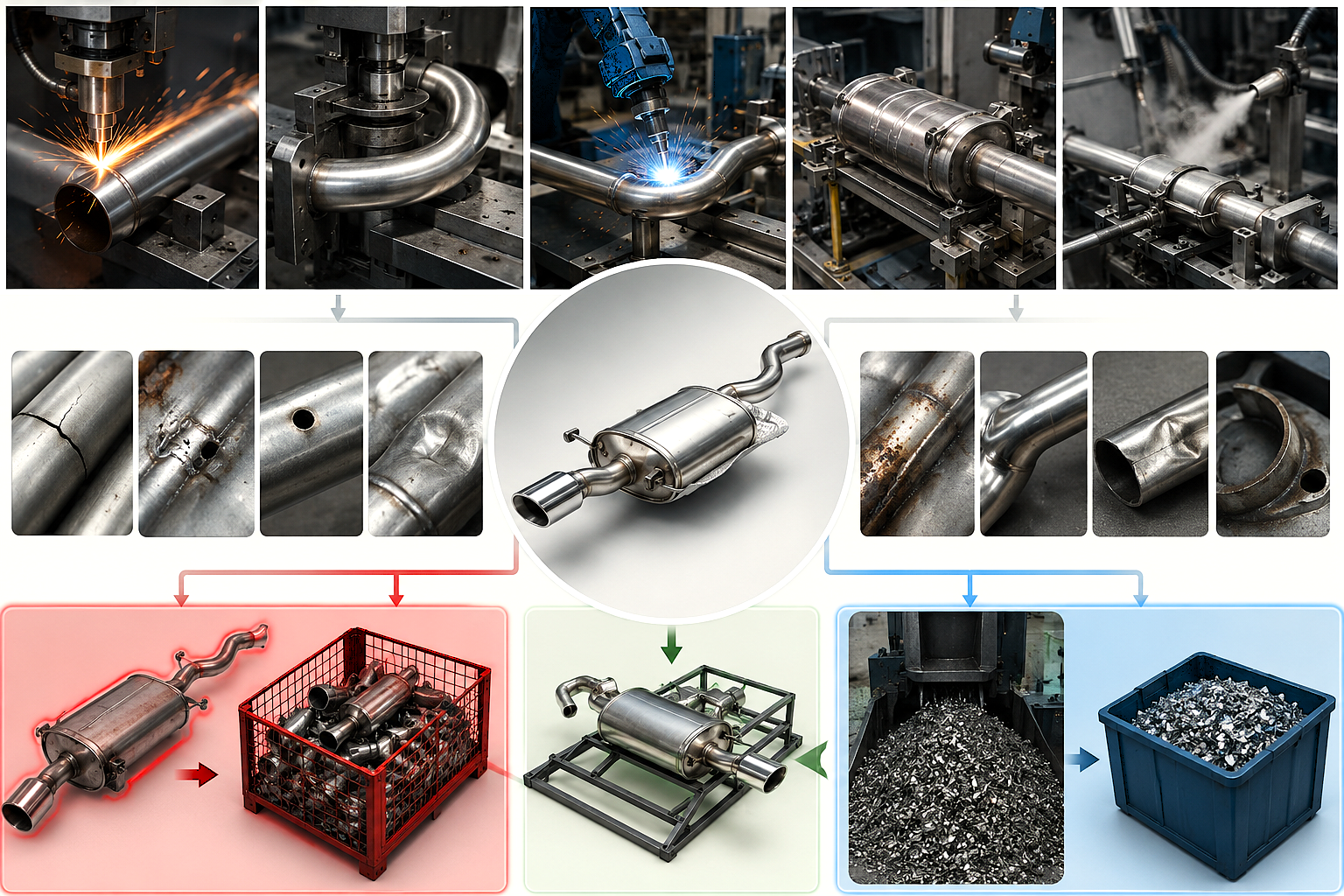
Automotive exhaust system manufacturing involves multiple high-precision processes such as pipe bending, stamping, welding, forming, assembly, leak testing, coating, and inspection. Because exhaust systems operate under high temperature, vibration, pressure, and corrosion conditions, strict quality control is essential.
Common NG (Non-Good) defects occur during production due to material problems, machine conditions, operator errors, welding issues, dimensional variation, and contamination.
Major NG Areas in Automotive Exhaust System Manufacturing
1. Welding Defects
Automotive exhaust systems contain many welded joints including pipes, brackets, mufflers, catalytic converter shells, and flanges.
Common NG Types
- Weld crack
- Porosity
- Incomplete penetration
- Burn-through
- Excessive spatter
- Weak weld joint
- Weld leakage
How It Happens
- Incorrect welding current or voltage
- Poor robot welding parameter setting
- Dirty material surface (oil, rust, moisture)
- Misalignment of parts before welding
- Inconsistent shielding gas
- Excessive heat input causing distortion
Impact
- Exhaust gas leakage
- Noise problems
- Structural failure during vehicle operation
- Rejection during leak test or durability test
Modern factories use robotic welding and automated monitoring systems to reduce weld defects and scrap.
2. Exhaust Leakage
Leakage is one of the most critical NG issues because exhaust systems must remain airtight.
Common Leak Areas
- Weld seams
- Pipe joints
- Flange connections
- Muffler seams
- Sensor ports
How It Happens
- Pinholes in welding
- Cracked joints from thermal stress
- Poor gasket sealing
- Improper clamping force
- Material thinning from corrosion
Detection Method
- Air leak tester
- Helium leak test
- Smoke testing
- Bubble testing
Even small leaks can affect engine sensor accuracy and catalytic converter performance.
3. Pipe Bending and Dimensional NG
Exhaust pipes require precise geometry to fit vehicle layouts.
Common NG Types
- Incorrect bend angle
- Flattened pipe
- Wrinkle formation
- Dimensional out-of-spec
- Misalignment
How It Happens
- Incorrect bending die setup
- Tool wear
- Improper material thickness
- Excessive bending force
- Springback effect of metal
Impact
- Assembly interference
- Installation failure
- Vibration and noise
- Fitment rejection at OEM assembly line
Sheet metal and tube forming defects are major scrap sources in automotive manufacturing.
4. Corrosion and Surface Defects
Exhaust systems operate in severe heat and moisture conditions.
Common NG Types
- Rust
- Pitting corrosion
- Surface oxidation
- Discoloration
- Coating peel-off
How It Happens
- Poor stainless-steel quality
- Exposure to moisture and salt
- Inadequate coating thickness
- Contaminated material storage
- Condensation inside mufflers
Impact
- Reduced durability
- Exhaust perforation
- Warranty claims
- Customer complaints
Internal corrosion from exhaust gas condensation is a major failure source in mufflers and tailpipes.
5. Material Defects
Raw material quality directly affects exhaust performance.
Common NG Types
- Incorrect material grade
- Thickness variation
- Surface scratches
- Lamination defects
- Contaminated steel
How It Happens
- Supplier quality variation
- Improper storage
- Mixing of material lots
- Incoming inspection failure
Impact
- Cracking during forming
- Welding instability
- Corrosion issues
- Reduced product life
Material inconsistency is a major root cause of automotive quality problems.
6. Bracket and Assembly NG
Exhaust assemblies include hangers, brackets, shields, and sensors.
Common NG Types
- Missing parts
- Wrong orientation
- Loose bracket
- Incorrect torque
- Assembly interference
How It Happens
- Human assembly error
- Incorrect jig positioning
- Fixture wear
- Poor poka-yoke system
Impact
- Vehicle vibration
- Noise issue
- Assembly line stoppage
- Field failure
Major Scrap Sources in Exhaust System Manufacturing
| Production Area | Typical Scrap / NG |
|---|---|
| Pipe Cutting | Incorrect length, burr |
| Pipe Bending | Wrinkle, deformation |
| Stamping | Crack, dent |
| Welding | Leak, crack, spatter |
| Assembly | Missing component |
| Surface Treatment | Rust, coating defect |
| Leak Testing | Air leakage |
| Final Inspection | Dimension out of spec |
How Factories Separate NG and Waste According to BOI Scrap Regulation
Companies operating under Thailand’s BOI (Board of Investment) privileges must control and record scrap carefully because imported raw materials receive tax exemption benefits.
Types of Scrap Classification
1. Production Scrap
Generated during normal manufacturing process.
ตัวอย่าง:
- Pipe trimming
- Welding spatter
- Metal off-cuts
- Stamping skeletons
2. NG Product Scrap
Finished or semi-finished parts that fail inspection.
ตัวอย่าง:
- Leak NG muffler
- Cracked welded pipe
- Rusted exhaust assembly
- Dimensional NG product
3. Raw Material Scrap
Unused or damaged imported material.
ตัวอย่าง:
- Rusted steel coils
- Expired materials
- Damaged stainless tubing
BOI Scrap Separation Process
Step 1 — Identification
Factory separates NG and scrap by:
- Material type
- Process origin
- BOI / Non-BOI status
- Reusable or non-reusable condition
Each scrap lot receives:
- Scrap tag
- Quantity record
- Traceability document
- Photo evidence
Step 2 — Segregation Area
Factories create dedicated:
- NG quarantine zones
- Scrap storage areas
- Locked BOI scrap areas
BOI materials must not mix with local non-BOI waste.
Step 3 — Recording and Traceability
Typical records include:
- Part number
- Lot number
- Weight
- ปริมาณ
- Defect reason
- Process source
- Destruction method
Step 4 — Scrap Inspection
Authorized inspection companies verify:
- Actual quantity
- Material condition
- Destruction process
- Compliance evidence
Companies such as Advantage Co., Ltd. provide BOI Scrap Inspection and certification services in Thailand.
Step 5 — Destruction or Disposal
Common disposal methods:
- Crushing
- Cutting
- Melting
- Shredding
- Authorized recycling
The purpose is to ensure defective BOI materials cannot re-enter production illegally.
Step 6 — Certificate Issuance
Inspection company issues:
- Scrap inspection certificate
- Quantity verification
- Destruction evidence
- Photo documentation