


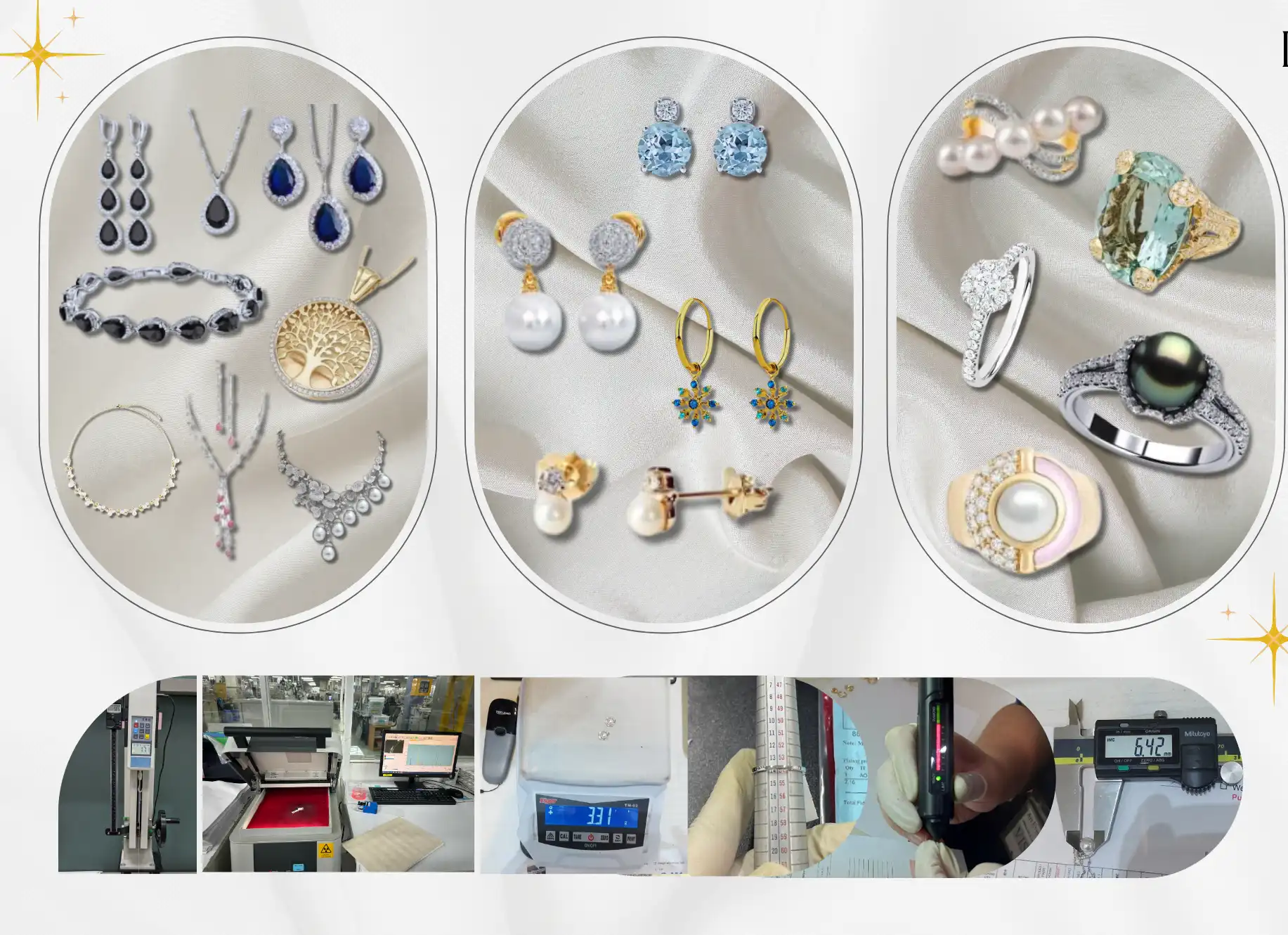
In the world of fine jewellery, beauty is expected. What separates a luxury brand from a budget counterfeiter is not just the carat weight or the metal stamp—it is consistency, safety, and structural integrity. A single loose prong or a microscopic porosity can turn a cherished heirloom into a liability.
For jewellers, implementing a rigorous Quality Inspection (QI) protocol is not merely a manufacturing step; it is a brand safeguard. Here is how professional quality inspection works across the jewellery production lifecycle.
The Four Pillars of Jewellery Inspection
Effective jewellery QA is divided into four distinct stages, often summarized by industry experts as the “Incoming, In-Process, Final, and Functional” checks.
1. Incoming Material Inspection (Raw Goods)
Before a torch is lit, the raw materials must be validated.
- Metal Purity: Using XRF (X-ray fluorescence) analyzers to verify karatage (e.g., 14k, 18k) without destroying the sample.
- Gemstone Integrity: Checking for clarity, colour matching, and the absence of treated fractures or “glass filling” in rubies and emeralds.
- Finding Durability: Inspecting clasps, jump rings, and earring backs for spring tension and solder joint strength.
2. In-Process Dimensional Inspection
During casting, setting, and polishing, dimensional accuracy is key—especially for mass production.
- Micro-Measurement: Using digital callipers to ensure ring shanks meet specific width and thickness tolerances (usually ±0.1mm).
- Stone Setting Check: Verifying that prongs sit flush against the stone’s girdle and that bezels have no gaps where dirt or moisture can collect.
- Porosity Detection: Visual inspection under magnification for pinholes or bubbles caused by improper casting temperature, which leads to brittleness.
3. Visual & Aesthetic Final Inspection
This is the “human eye” stage, often conducted under standardized lighting (e.g., 5000k daylight bulbs).
- Scratch & Tool Mark Audit: Checking for polishing swirls or rough patches on the inside of a ring (a common cut corner).
- Plating Uniformity: For rhodium-plated white gold or gold-vermeil, inspectors look for “bald spots” or peeling edges.
- Symmetry: Ensuring that earring pairs match in weight and length, and that engagement rings are not “warped” on the mandrel.
4. Functional & Mechanical Testing
A piece of jewellery must survive daily wear. Static inspection is not enough.
- Clasp Tension Testing: A safety clasp on a pearl strand must withstand a pull test (often 10-15 lbs) without opening.
- Prong Security: Using a fine needle to attempt to lift or shift a stone. If the stone moves, the setting fails.
- Hinge & Joint Action: Testing folding mechanisms in bangles or hidden clasps for smooth, non-gritty movement.