


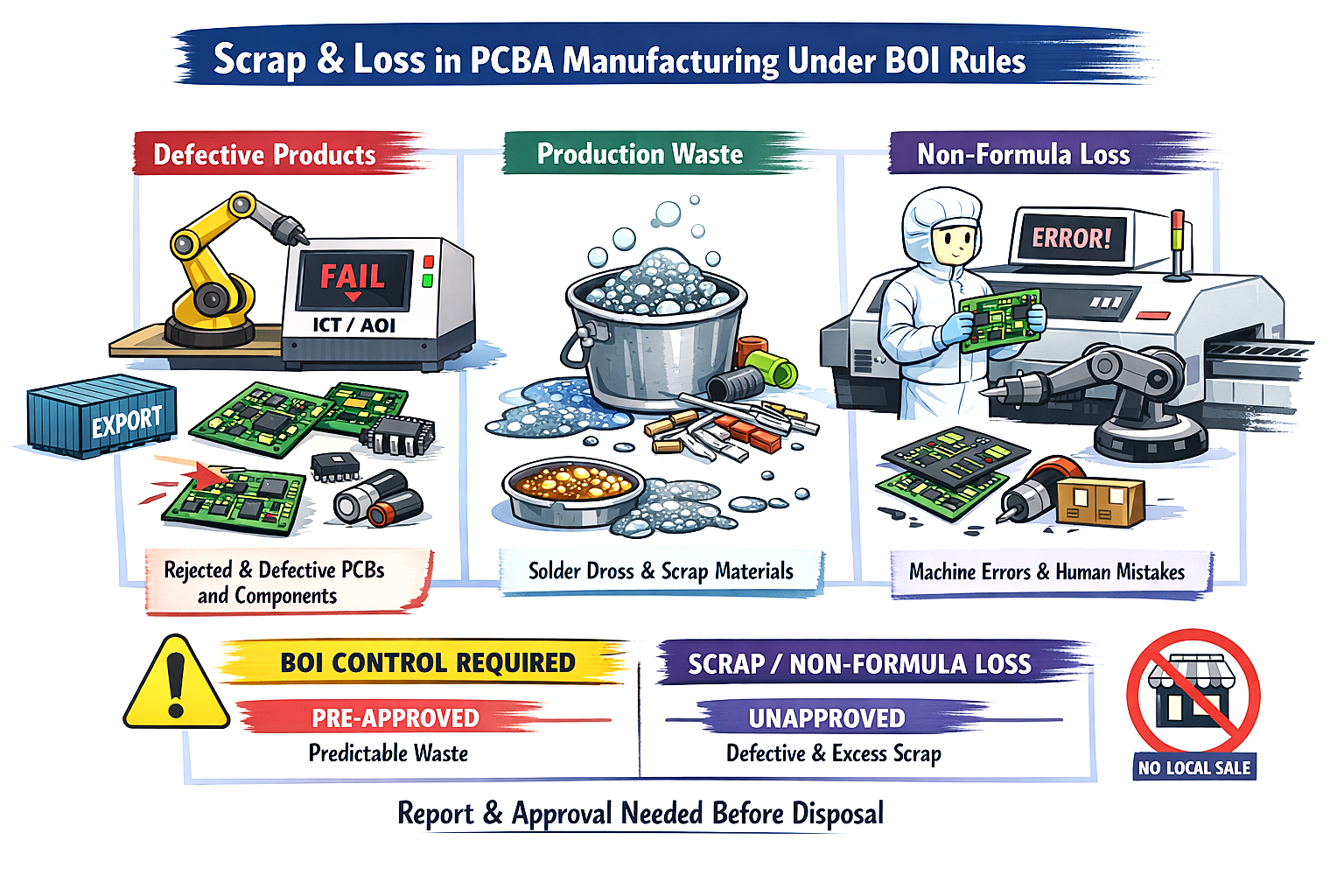
Under Thailand BOI regulations—particularly those enforced under Section 36 of the Investment Promotion Act—scrap . loss refer to raw materials, components, or in-process goods that cannot be used or sold as intended during PCBA manufacturing.
These are unavoidable by-products of the electronics assembly process, but they are not part of the approved formula loss
🔧 In the Context of PCBA Manufacturing
For Printed Circuit Board Assembly (PCBA), scrap or loss typically arises due to:
1️⃣ Defective or Sub-Standard Materials
Materials or assemblies that fail to meet quality or functional requirements, such as:
- PCBAs failing ICT, FCT, or AOI
- Damaged PCBs (warping, burnt pads, lifted traces)
- Faulty ICs, resistors, capacitors, or connectors
- Solder defects (bridging, cold solder, insufficient solder)
These items cannot be shipped or reworked economically.
2️⃣ Production Waste or Leftover Materials
Unusable materials generated during normal production operations, including:
- Solder paste residue and expired solder paste
- Excess solder dross from wave soldering
- Cut component leads and rejected reels
- Scrapped panels after depaneling
- Misprinted or damaged solder stencils
This waste is process-driven . non-recoverable.
3️⃣ Non-Formula Loss (Unpredictable Loss)
Loss that:
- Cannot be accurately forecast in advance
- Is not included in the BOI-approved BOM or production formula
- Results from process variation, human error, or machine malfunction
ตัวอย่าง:
- Wrong component loaded during SMT setup
- Programming errors causing mass rejection
- ESD damage during handling
- Machine calibration failure leading to batch scrap
BOI classifies these as non-formula loss, which requires proper justification and approval before disposal or domestic sale.