


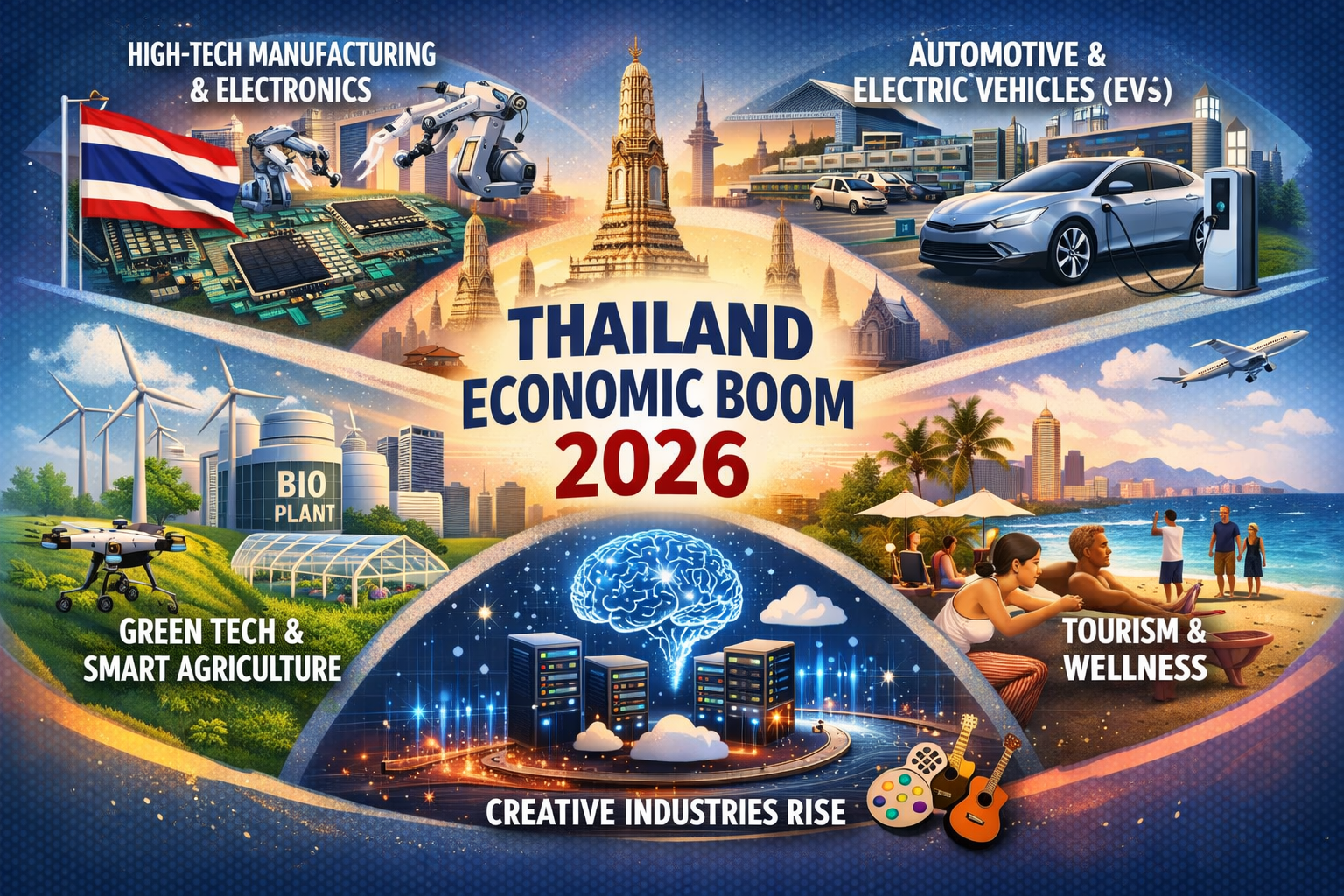
🔎 1) Major Sectors Poised to Boost Thailand’s Economy in 2026
📊 High-Tech Manufacturing & Electronics
• Thailand is attracting strong investment in electronics, electrical appliances, semiconductors and components — positioning these as key drivers of growth in 2026. According to projections, digital and electronics industries alongside automotive constitute core pillars of future economic expansion.
• Printed Circuit Boards (PCBs) and smart electronics segments are expected to grow strongly, with regional and global interest in advanced electronics manufacturing increasing.
• There’s noticeable attention on semiconductor production and “Made in Thailand” capabilities, highlighting potential tech-driven industrial growth.
🚗 Automotive & Electric Vehicles (EVs)
• The automotive sector (particularly EVs and components) remains another core growth area, with continued strong BOI investment interest and production capacity development.
• EV electrification and related supply chains — batteries, charging infrastructure, power electronics — form part of New S-Curve sectors the government intends to develop.
💻 Digital Economy, AI & Data Centers
• Digital transformation, data centers, AI, and software services are flagged as priority growth engines through 2026, with Thailand aiming to strengthen digital adoption and innovation ecosystem.
• Investment pipelines show strong interest in cloud computing infrastructure — foundational for smart manufacturing, e-commerce, and connected industries.
🌱 Green Tech, Bio-Economy, Smart Agriculture
• Investments in green chemicals (e.g., bio-ethylene plant investment) signal the push toward sustainable and circular industrial models.
• Smart farming and agri-tech are also strategic growth areas, using IoT, AI, drones and data analytics to transform agriculture into a higher value-added sector from 2026 onward.
🍽️ Health, Wellness & Tourism Revival
• Health & nutrition fairs and innovation events reflect a broader trend of growth around nutrition, wellness, livestock advancements, and service industries complementing production sectors.
• The tourism sector is also gaining momentum and expected to significantly strengthen retail, hospitality and service value chains — indirectly supporting localized manufacturing and consumption.
📍 2) Key Manufacturing & Industry Developments (January 2026)
🧪 National Industrial Strategy & Plans
• Thailand’s 14th National Economic and Social Development Plan was unveiled to accelerate growth through innovation, investment attraction and modernization — emphasizing smart manufacturing, digital transformation and high technology adoption.
• Major political parties are outlining industrial vision plans for the 2026 election, with focus areas including EVs, data centers, AI, sustainable energy and logistics — underlining sector support that will shape manufacturing policy.
🏭 Green Investments & Industrial Innovation
• Braskem Siam’s 19,300 MB investment in a bio-ethylene plant reinforces Thailand’s drive toward green industrial manufacturing and sustainable chemical production models.
• Manufacturing innovation events such as Automation Thailand and PCB Thailand 2026 are planned to showcase automation, smart systems and advanced electronics technologies — promoting industrial competitiveness.
⚠️ Economic & Manufacturing Headwinds
• Industry bodies warn of a “perfect storm” of economic pressures including weak capacity utilization, low-value exports and global trade strain — potentially slowing manufacturing growth if competitiveness isn’t strengthened.
• Structural issues like underinvestment in labour skills, energy costs, and regulatory compliance remain ongoing challenges for manufacturing firms.
🎨 Rising Creative & Services Sectors
• Beyond traditional manufacturing, Thailand is promoting a “Creative Nation” economy — expanding design, media, content and creative services as complementary growth segments.
📌 3) Broader Trends Affecting Manufacturing in 2026
- Global trade tensions could shift production and investment flows to Thai manufacturing hubs.
- Energy transitions (e.g., LNG supply deals) support stable energy for industrial production.
- Export markets will still be crucial, with products like automobiles, electrical appliances and food products expected to maintain demand.