


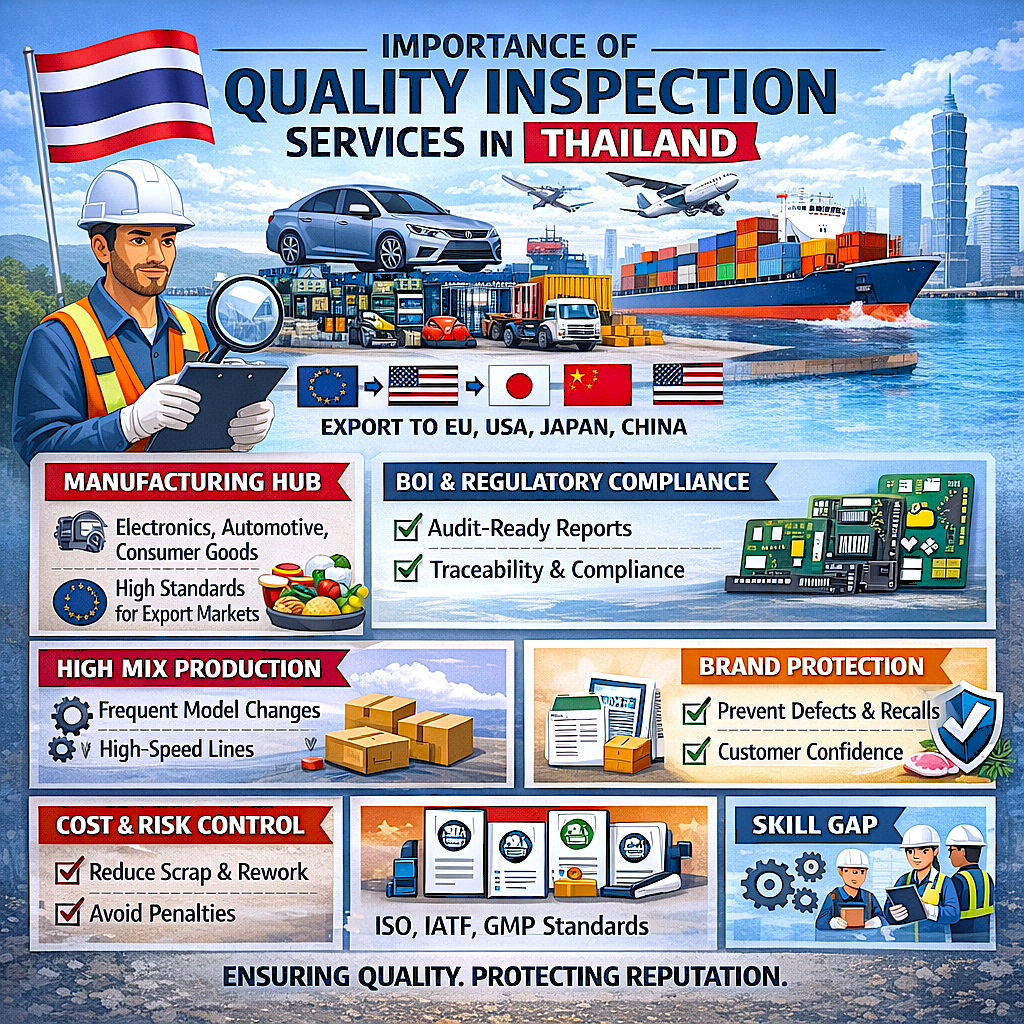
1. Thailand = Global Manufacturing & Export Hub 🇹🇭
Thailand is a key production base for:
- Electronics & PCBA/SMT
- Automotive & EV parts
- Hard disk drives & semiconductors
- Consumer goods, appliances, and food processing
Most products made in Thailand are exported to high-standard markets like the EU, USA, Japan, and China. These markets demand zero tolerance for quality failure, making inspection services critical.
2. BOI & Regulatory Compliance Pressure
Thailand’s Board of Investment (BOI) provides strong incentives—but with strict conditions:
- Material usage control
- Scrap & non-formula loss verification
- Traceability and destruction proof
- Audit-ready documentation
Independent quality inspection ensures:
- BOI-ready reports
- Reduced audit risk
- Transparent, third-party verification
This is a major reason factories rely on inspection services in Thailand.
3. High Mix, High Speed Manufacturing Environment
Thailand factories often run:
- High-mix, low-volume production
- Multiple customers on the same line
- Frequent model changes
This increases the risk of:
- Wrong parts
- Process deviation
- Missed defects
On-site quality inspectors help catch issues before shipment, not after customer complaints.
4. Customer Trust & Brand Protection
Global customers increasingly require:
- Third-party inspection
- Pre-shipment checks
- Process audits and line verification
Quality inspection services:
- Protect brand reputation
- Prevent recalls and returns
- Provide neutral, credible inspection evidence
For overseas buyers, independent inspection in Thailand = confidence.
5. Cost Control & Risk Reduction
Finding defects late is expensive. Inspection services help:
- Reduce rework and scrap
- Prevent shipment rejection
- Avoid penalties and chargebacks
In Thailand’s competitive manufacturing landscape, quality failures directly hit profit margins.
6. Workforce Variation & Skill Gaps
Thailand has a strong workforce, but:
- High labor turnover in some industrial zones
- Mixed skill levels across shifts
- Communication gaps with global customers
Third-party inspectors act as a quality gatekeeper, ensuring consistent standards across all shifts.
7. Support for Audits & Certifications
Quality inspection services support:
- ISO 9001 / IATF 16949 / ISO 13485 readiness
- Customer audits
- Internal quality improvement
They provide documented evidence—not just verbal assurance.